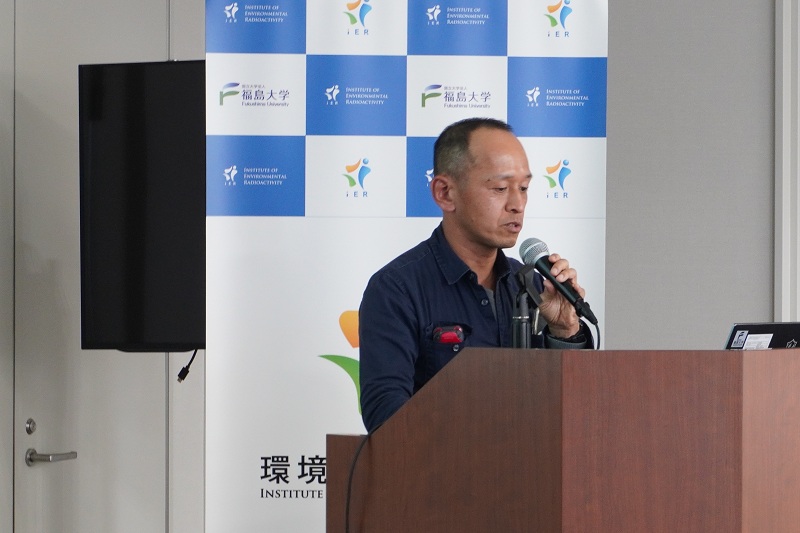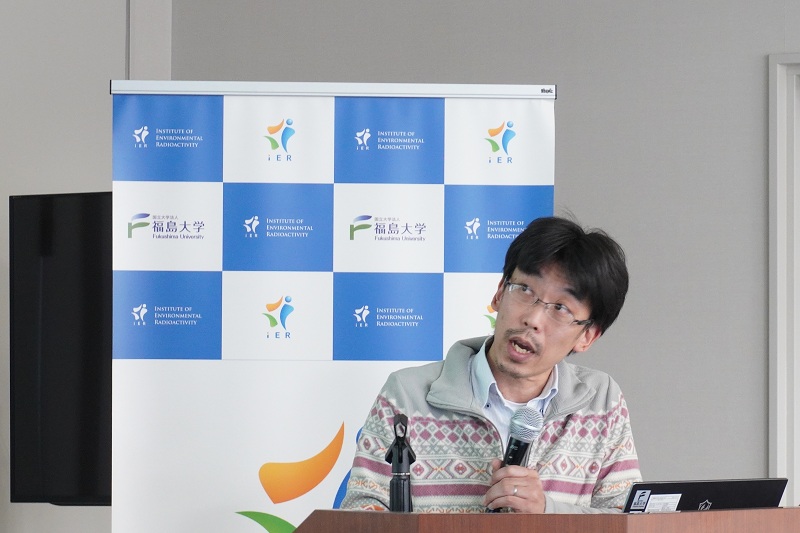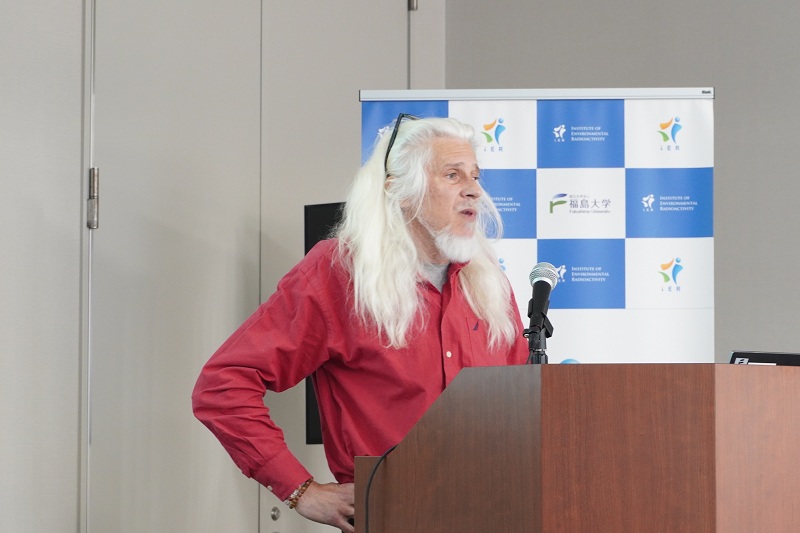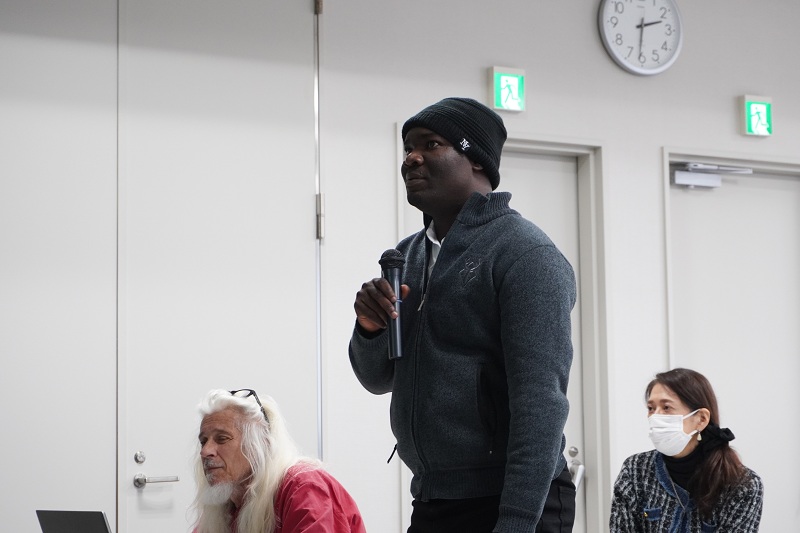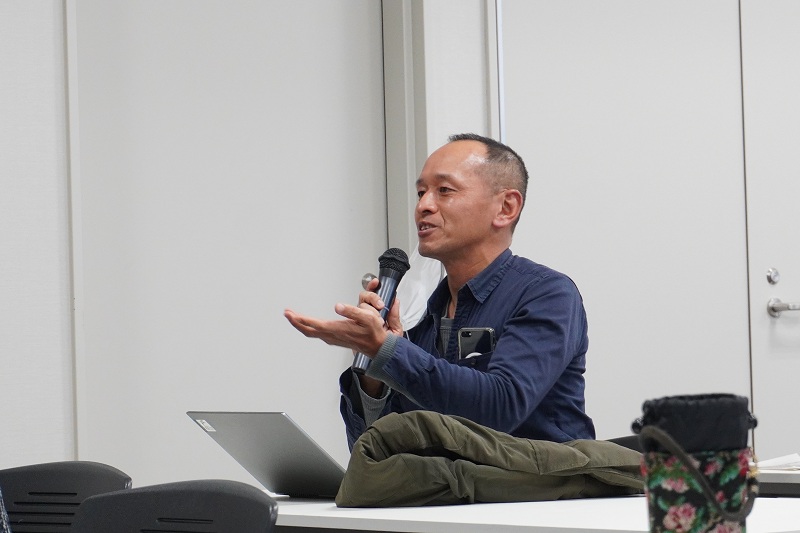
The 6th IER Seminar of FY2025 held on November 17, 2025 (Project Researcher Kanasashi, Associate Professor Hirao, Professor Yoschenko)
| Date & Time | Mon. November 17, 2025, 13:30-15:00 JST |
| Venue | 6F Conference Room, IER Main Building / Online (Zoom) |
| Speakers | KANASASHI Tsutomu (Project Researcher) HIRAO Shigekazu (Associate Professor) Vasyl YOSCHENKO (Professor) (Presentation order) |
| Lecture Titles | Temporal changes in 137Cs deposition from airborne monitoring, without considering Cs migration in forests, reflect Cs redistribution in forests. (Kanasashi) An investigation of environmental tritium in Fukushima, Japan and its implication for environmental assessment (Hirao) Application of isotopic approach to assess the quasi-equilibrium levels of 137Cs in Fukushima forests (Yoschenko) |
| Participants | 25 |
Institute of Environmental Radioactivity (IER) regularly holds the IER Seminar in which the faculty members report on their research results, with the aim of facilitating their research activities and promoting communication.
In the 6th IER Seminar of this fiscal year that was held on November 17, 2025, three presentations were given by Project Researcher KANASASHI Tsutomu, Associate Professor HIRAO Shigekazu, and Professor Vasyl YOSCHENKO to 25 participating researchers and students as follows.
Project Researcher Kanasashi presented the decline in 137Cs deposition in forests estimated from airborne monitoring has been found to be greater than that obtained from ground-based measurements. The discrepancy was attributed to the use of a constant conversion factor from ambient dose rate to deposition throughout the period since 2011. However, he hypothesized that the temporal decrease in deposition reflects the rate at which 137Cs migrated from aboveground components to the soil within forests. Using a double-exponential model, he estimated the time required for the majority of 137Cs to transfer into the soil after the nuclear accident.
Associate Professor Hirao presented the development status and performance evaluation of a new measurement system for tritiated water vapor in the atmosphere, aiming to elucidate short-term variations in its concentration. He explained that the system is portable, does not require commercial power supply, and enables continuous measurements for several days. Preliminary laboratory experiments demonstrated that the system maintains the collection efficiency required for field observations. Field tests conducted in Fukushima confirmed successful measurements of tritiated water vapor concentrations at intervals of several hours without using commercial power. Finally, he stated that this system will contribute to enhancing emergency monitoring at tritium-emission facilities.
Professor Yoschenko presented the latest achievements in the IER forest project. First, he briefly discussed the 137Cs/K exchangeable form ratio in soil as a local factor regulating the root uptake of 137Cs into the aboveground cedar forest biomass. He then focused on the isotopic approach as a main topic of the presentation. He explained the details of the approach and the history of its application. A case study in Yamakiya cedar forest using this approach demonstrates the achievement of quasi-equilibrium of 137Cs in tree biomass. Finally, Prof. Yoschenko presented the dynamics of 137Cs inventory in the aboveground tree biomass in this ecosystem and compared it with model predictions from other studies.
After each presentation, various questions and comments were raised by participants.