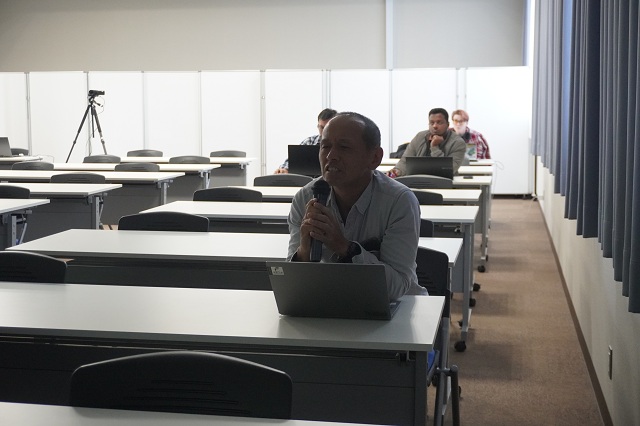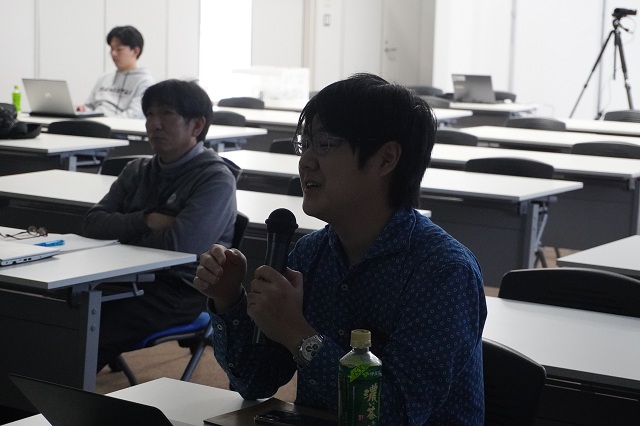
On October 20, 2025, 4th IER Seminar of FY2025 was held <graduate students>
| Date & Time | Mon. October 20, 2025, 13:30-15:00 JST |
| Venue | 6F Conference room, Main Bldg. IER/Online (Zoom) |
| Speakers | HOSHI Shota (2nd-year master’s student, major in Environmental Radioactivity) MASHIKO Atsushi (2nd-year master’s student, major in Environmental Radioactivity) SUZUKI Nobuhiro (3rd-year doctoral student, major in Environmental Radioactivity) (Presentation order) |
| Lecture Titles | Seasonal changes in 137Cs concentration and diet of masu salmon: a year-round study in two rivers (Hoshi) Evaluation of environmental factors affecting the concentration of 137Cs in Japanese eel from estuary to midstream regions (Mashiko) Variations of 137Cs concentrations in suspended solids in the Abukuma River during high-water events (Suzuki) |
| Participants | 21 |
Institute of Environmental Radioactivity (IER) regularly holds the IER Seminar in which the faculty members report on their research results, with the aim of facilitating their research activities and promoting communication.
In the 4th IER Seminar of this fiscal year that was held on October 20, 2025, three presentations were given by two master’s students and one doctoral student majoring in Environmental Radioactivity to 21 participating researchers and students as follows.
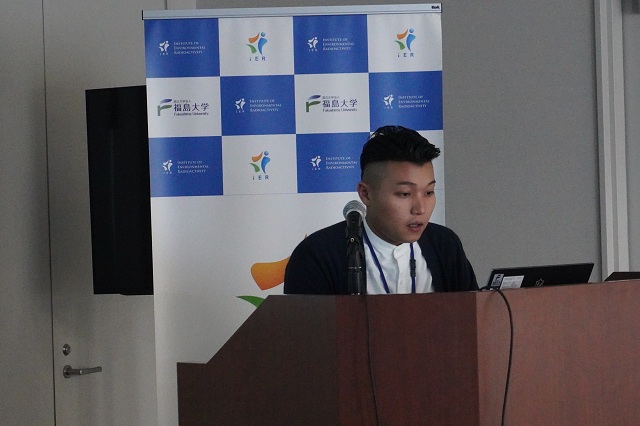
Mr. Hoshi in Wada Laboratory presented the results of a year-round seasonal survey conducted in two rivers of the Ukedo River system on the seasonal variations in the diet of masu salmon and their 137Cs concentrations. Fish were collected, and their stomach contents were taxonomically identified and analyzed for 137Cs concentrations. The results showed that terrestrial insects dominated the diet in summer and autumn, while aquatic insects were predominant in winter and spring. The 137Cs concentrations in fish muscle were consistently higher in the Ogaki-shita than in the Kodeya River, but both sites exhibited similar seasonal trends: concentrations increased from summer to autumn, decreased from autumn to spring, and rose again from spring to summer. These findings suggest that seasonal dietary shifts strongly influence the temporal dynamics of 137Cs accumulation in masu salmon within contaminated freshwater ecosystems.
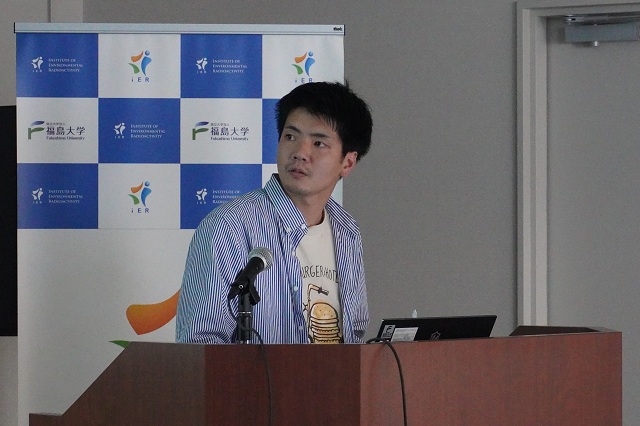
Mr. Mashiko in Wada Laboratory presented evaluation of environmental factors affecting the concentration of 137Cs in Japanese eel from estuary to midstream regions. The ecological characteristics of this species, such as its euryhalinity and sedentary behavior in river habitats, are said to make it an indicator species for the environment. Therefore, using this species as an indicator, we evaluated the transfer of 137Cs to fish from environmental factors such as water, riverbed sediments, and attached algae. The results suggest that the concentration of 137Cs in riverbed sediments, which indicates the degree of river contamination, and the concentration of 137Cs in attached algae that serve as a nutrient source for the river ecosystem influence the concentration of 137Cs in this species.
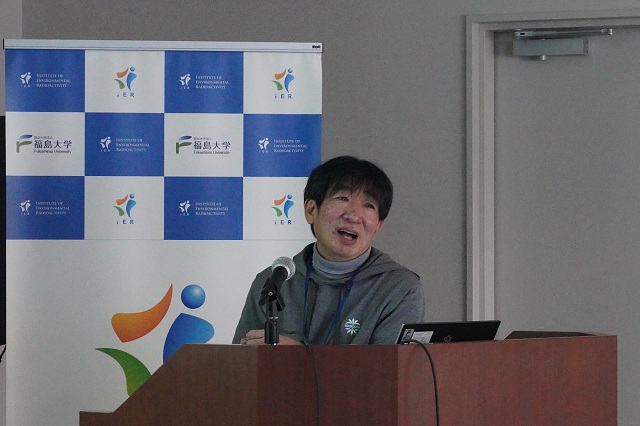
Mr. Suzuki in Wakiyama Laboratory presented variations of 137Cs concentrations in suspended solids in the Abukuma River during high-water events. They present datasets of 137Cs concentrations, carbon and nitrogen stable isotope signatures and heavy metal contents in suspended solids in the Abukuma river and discussed influence of land use composition in catchments on 137Cs dynamics. Mean values of normalized 137Cs concentration and δ15N in SS showed negative correlations with forest cover ratio on catchments. Normalized 137Cs concentrations in SS tended high when δ 15N were high. Interestingly, this relationship is opposite to those observed in the Hamadori rivers after a previous study. Comparison between 137Cs with the heavy metals showed that Pb content positively correlated with 137Cs concentrations at some sites. These results suggested that Pb could be used to assess the contribution of urban-origin suspended solids and 137Cs.
After each presentation, various questions and comments were raised by participants.