On October 6, 2025, 3rd IER Seminar of FY2025 was held <graduate students, International Visiting Scholar Cornillon>
| Date & Time | Mon. October 6, 2025, 13:30-15:00 JST |
| Venue | 6F Conference room, Main Bldg. IER/Online (Zoom) |
| Speakers | SUGENO Haruto (2nd-year master’s student, major in Environmental Radioactivity) YOSHIDA Asahi (2nd-year master’s student, major in Environmental Radioactivity) International Visiting Scholar Amaris CORNILLON (Presentation order) |
| Lecture Titles | Migration ecology and radiocesium uptake pathways in Japanese sea bass across marine–riverine habitats (Sugeno) Investigation of the transport mechanism of Rn-222 in East Asia using an atmospheric transport model (Yoshida) Towards renewable energy : post-disaster Fukushima as a case study of territorial energy transition (Cornillon) |
| Participants | 22 |
Institute of Environmental Radioactivity (IER) regularly holds the IER Seminar in which the faculty members report on their research results, with the aim of facilitating their research activities and promoting communication.
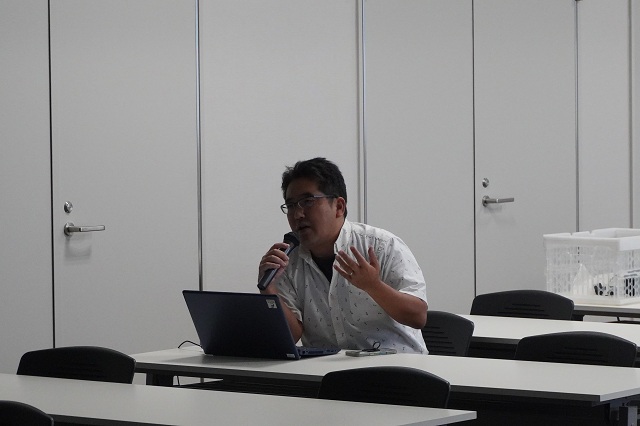
In the 3rd IER Seminar of this fiscal year that was held on October 6, 2025, three presentations were given by two master’s students majoring in Environmental Radioactivity and International Visiting Scholar Amaris CORNILLON to 22 participating researchers and students as follows.
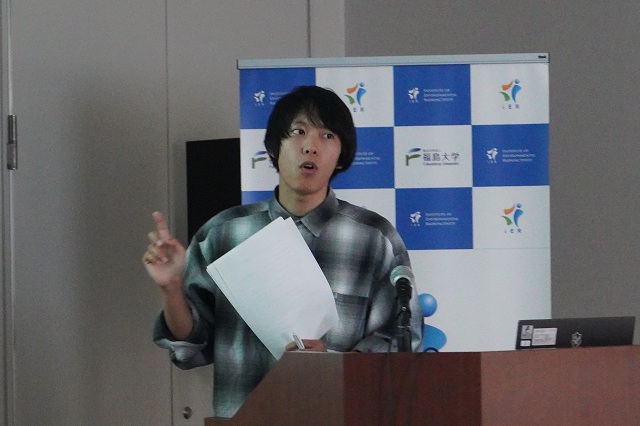
Mr. Sugeno in Wada Laboratory presented the partial migration of seabass. 137Cs, Sr/Ca ratio, and isotopes were used to trace their movements and diet. Estuaries contributed additional 137Cs, while growth in the sea diluted it.
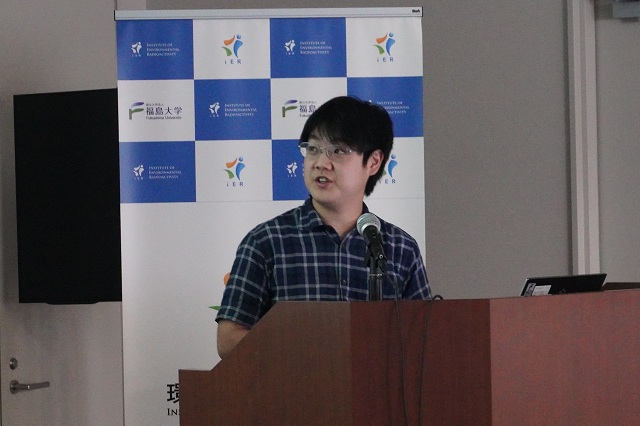
Mr. Yoshida in Hirao Laboratory presented his research titled “Investigation of the transport mechanism of Rn-222 in East Asia using an atmospheric transport model”. In this study, the atmospheric transport model SCALE-RM, developed by RIKEN, was used to simulate the atmospheric Rn-222 and its decay products concentrations. He demonstrated the evaluation of a model performance by comparing the atmospheric Rn-222 and its decay products concentrations between the model calculation and the observation and the estimation obtained from airborne radiological survey provided by previous works. As a result, the calculated temporal variation of atmospheric Rn-222 concentration near the surface showed fair agreement with the observations, whereas the calculated concentrations of the decay products in the atmosphere above the ground were inconsistent with the estimated values from previous studies. These results suggest that the atmospheric transport model used in this study can reproduce variations in Rn-222 concentration near the surface, while both the calculated and estimated values in the upper atmosphere involve uncertainties, indicating the need for further validation.
Mr. Cornillon presented the theoretical framework that will guide his research. Through the study of several key cases, his project aims to develop a better understanding of the energy transition toward renewable sources within a specific territorial context. To achieve this, it relies on a theoretical framework inspired by industrial and territorial ecology, as well as the anthropology of energy. Within this multidisciplinary framework, the territory is conceived as a metabolic system composed of interactions and flows among humans, between humans and non-humans, and among non-humans. Energy (including electricity) ensures the functioning of this metabolism by meeting primary needs and supporting associated practices such as heating and lighting. In this presentation, these issues were addressed through the metabolic analysis of two projects: the Mont Azuma solar power plant in the city of Fukushima, and the FH2R complex (Fukushima Hydrogen Energy Research Field), located in the city of Namie.
After each presentation, various questions and comments were raised by participants.