IER Special Seminars held on June 12 and June 19, 2026 (Dr. Thomas E. Johnson)
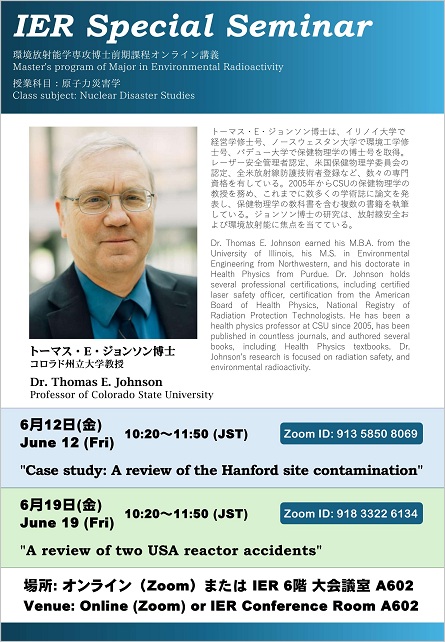
| Date & Time | (1) Friday, June 12, 2026, 10:20-11:50 JST (2) Friday, June 19, 2026, 10:20-11:50 JST |
| Venue | 6F Conference Room, IER Main Building / Online (Zoom) |
| Guest Speaker | Dr. Thomas E. Johnson (Colorado State University) |
| Lecture Titles | (1) Case study: A review of the Hanford site contamination (2) A review of two USA reactor accidents |
| Participants | (1) 33 (12 in-person, 21 online) (2) 25 (12 in-person, 13 online) |
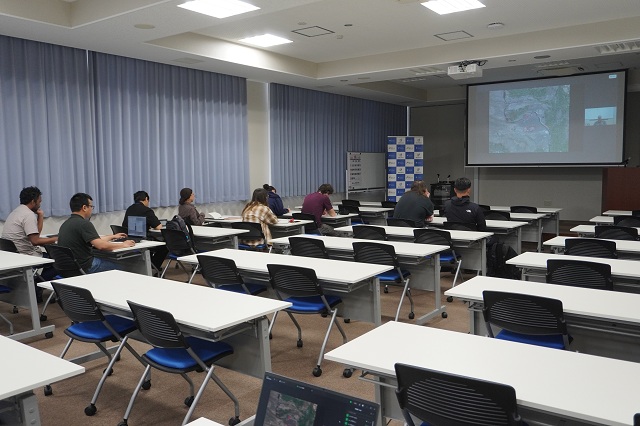
In some classes of the Master’s Program in Environmental Radioactivity, prominent researchers are invited as guest lecturers, and these classes are open to relevant professionals both within and outside the university as ‘Special Seminars’.
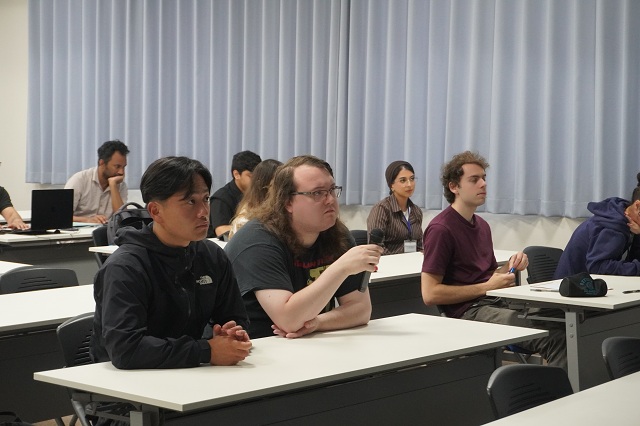
The lectures on ‘Nuclear Disaster Studies’ by Dr. Thomas E. Johnson, held on June 12 and June 19, were attended by a total of 58 participants, including master’s and doctoral students majoring in Environmental Radioactivity and IER affiliates.
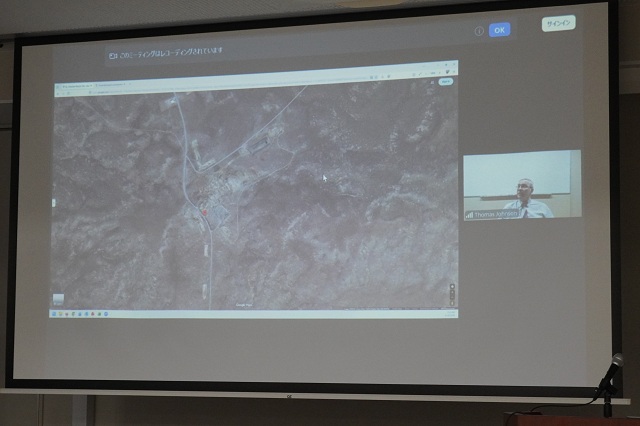
On June 12th, Dr. Johnson’s first talk introduced the Hanford site, which was established in 1943 to produce weapon-grade plutonium until 1990 in the Washington state, US. As a result, the Hanford site area of 1,650 km2 has many buried solid and liquid radioactive waste requiring continuous, extensive and expensive remediation efforts while groundwater is the main pathway of contamination movement from the Hanford site to the Columbia River.
On June 19th, the Dr. Johnson’s second talk focused on the Stationary Low-Power Reactor (SL-1) accident, which occurred on 3rd January 1961 in Idaho, and the Three Mile Island (TMI) accident that occurred on 28th March 1979 in Pennsylvania, US. Since the SL-1 was situated in the remote desert area of Idaho state, there were no remediation activities of contaminated soils while no detectable amounts of the long-lived radionuclides escaped to the environment in the TMI accident.