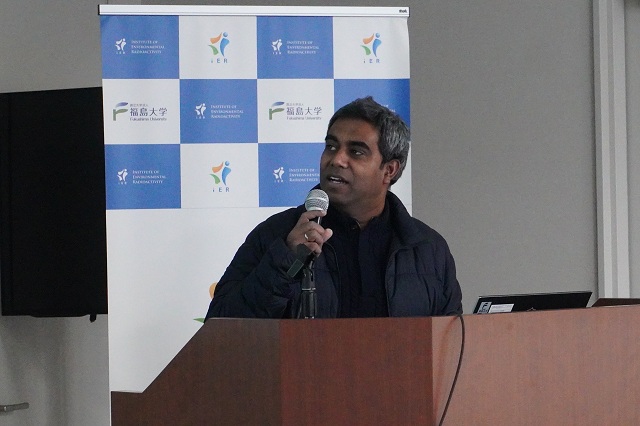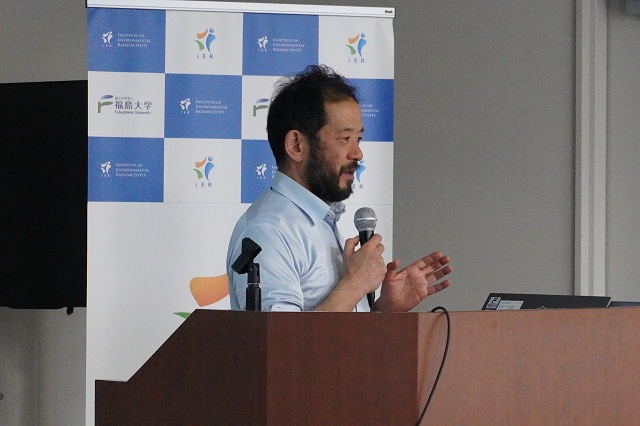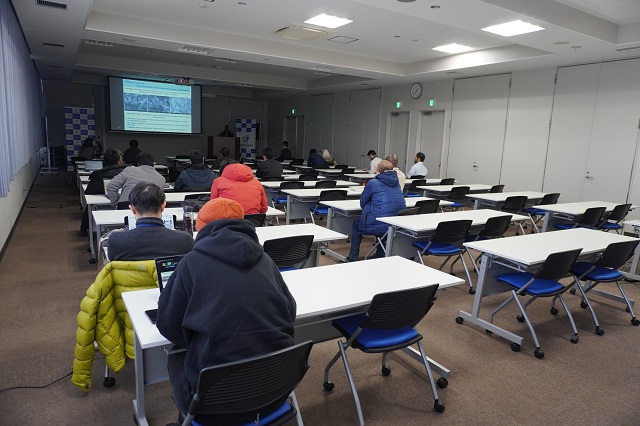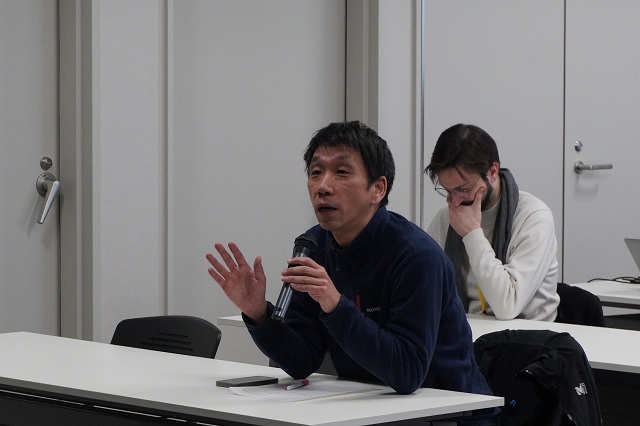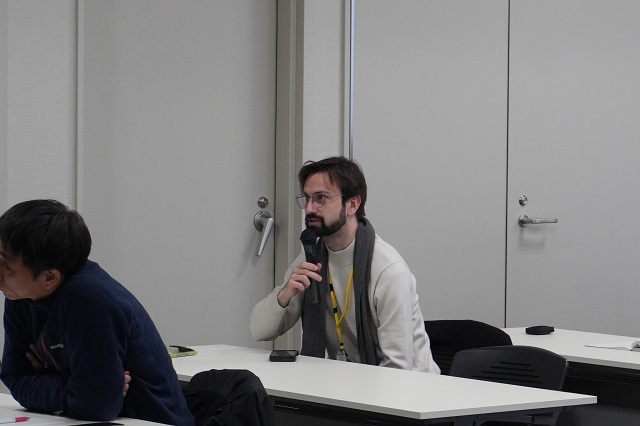
The 9th IER Seminar of FY2025 held on January 26, 2026 (Professor Rahman, Professor Nanba, Project Researcher Pavlenko)
| Date & Time | Monday, January 26, 2026, 13:30-15:00 JST |
| Venue | 6F Conference Room, IER Main Building / Online (Zoom) |
| Speakers | Professor RAHMAN Ismail Professor NANBA Kenji Project researcher Polina PAVLENKO (Presentation order) |
| Lecture Titles | Volume reduction of radionuclide-contaminated aqueous waste using a charcoal-ceramic composite (Phase II: Process optimization and application) (Rahman) Beekeeping in Hama-dori and giant hornet (Nanba) Efficacy of Prussian blue dietary additive and water salinity in reducing the 137Cs assimilation efficiency in Japanese dace (Pseudaspius hakonensis) (Pavlenko) |
| Participants | 27 |
Institute of Environmental Radioactivity (IER) regularly holds the IER Seminar in which the faculty members report on their research results, with the aim of facilitating their research activities and promoting communication.
In the 9th IER Seminar of this fiscal year that was held on January 26, 2026, three presentations were given by Professor RAHMAN Ismail, Professor NANBA Kenji, and Project researcher Polina PAVLENKO to 27 participating researchers and students as follows.
Professor Rahman presented “Volume reduction of radionuclide-contaminated aqueous waste using a charcoal-ceramic composite (Phase II: Process optimization and application).” He discussed the optimization of a sorbent material made from locally sourced cedar or cypress charcoal coated with ceramics. A key finding of the study was that specific “washing” protocols (optimally 4 cycles) significantly enhanced performance by removing blocking ions. The material demonstrated a retention rate of approximately 99% for 137Cs when tested with real contaminated water from Suzuuchi Pond, located in Okuma Town within the exclusion zone of the Fukushima Daiichi Nuclear Power Plant, proving it to be a low-cost and effective solution for treating radioactive wastewater.
Professor Nanba presented an analysis of 137Cs concentrations in the giant hornet (Vespa mandarinia) in the Hamadori region of Fukushima. In 2023 and 2024, experimental beekeeping was conducted in collaboration with French researchers at four sites within the Difficult-to-Return Zone and two sites in non-evacuated areas. Since V. mandarinia causes devastating damage to Western honeybee colonies, various control measures have been developed. In this study, in addition to trap-based control, hornets were captured for approximately one hour at each site during hive inspections conducted every two weeks. The foraging range of V. mandarinia is generally considered to be about 2 km from the nest. Analysis of carbon and nitrogen stable isotope ratios in individual hornets suggested that individuals visiting a single apiary might originate from multiple colonies. Furthermore, by combining individual 137Cs concentrations with spatially heterogeneous deposition maps of 137Cs at the kilometer scale, it may be possible to estimate the locations of hornet nests.
Project researcher Pavlenko presented a study on the efficacy of dietary Prussian Blue additives and water salinity in reducing 137Cs bioaccumulation in Japanese dace. By employing a kinetic model accounting for growth dilution, the research evaluated how different treatments affect assimilation efficiency and excretion rates. She demonstrated that Prussian Blue significantly lowers radiocaesium assimilation from feed, while increased salinity reduces uptake and notably accelerates excretion. Finally, she detailed the proportion of radiocaesium over time in muscle tissue increases over time as it retains the 137Cs longer than other body parts, which excrete it at a significantly faster rate.
After each presentation, various questions and comments were raised by participants.