The 12th IER Seminar of FY2025 held on February 16, 2026 (Visiting Scholar Zinnat, Project Researcher Orosun, Project Professor Torii)
| Date & Time | Monday, February 16, 2026, 13:30-15:00 JST |
| Venue | 6F Conference Room, IER Main Building / Online (Zoom) |
| Speakers | Visiting Scholar RAHMAN Zinnat Project Researcher Muyiwa Michael OROSUN Project Professor TORII Tatsuo (Presentation order) |
| Lecture Titles | Approaches for remediation of radionuclide-contaminated soils (Zinnat) Distribution of 137Cs in Japanese cedar and its implications for sustainable forest management in Fukushima (Orosun) Development of an omnidirectional detector for neutron imaging with fractal geometry (Torii) |
| Participants | 24 |
Institute of Environmental Radioactivity (IER) regularly holds the IER Seminar in which the faculty members report on their research results, with the aim of facilitating their research activities and promoting communication.
In the 12th IER Seminar of this fiscal year that was held on February 16, 2026, three presentations were given by Visiting Scholar RAHMAN Zinnat, Project Researcher Muyiwa Michael OROSUN, and Project Professor TORII Tatsuo to 24 participating researchers and students as follows.
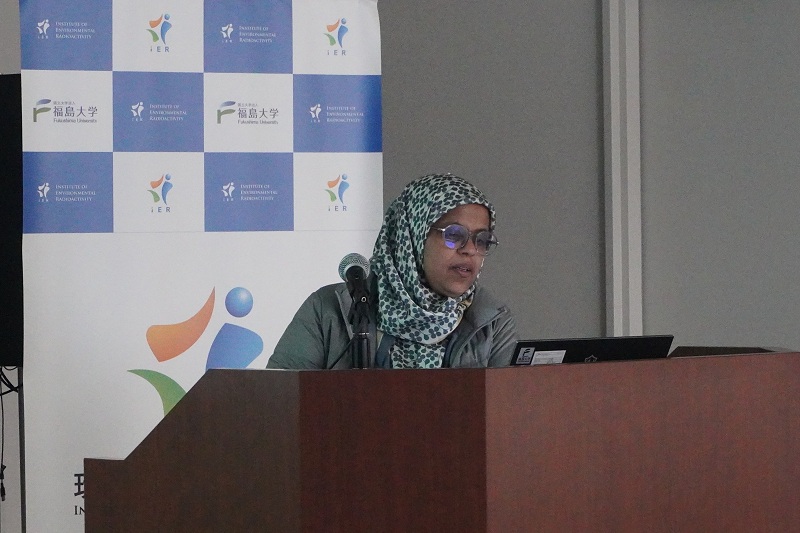
Visiting Scholar Zinnat presented methods for remediating radiocesium (137Cs)-contaminated soils following the Fukushima Daiichi accident, comparing chemical extraction with a novel volume-reduction approach. Results indicate that, while persistent and biodegradable chelators exhibit lower extraction efficiency than ammonium salts, dispersant-enhanced wet sieving with sodium hexametaphosphate (SHMP) is highly effective. SHMP facilitates dispersion of soil microaggregates by disrupting polyvalent cation bonds, effectively concentrating 137Cs into the fine clay and silt fractions (< 125 µm). It allows larger, decontaminated soil fractions to be separated and potentially reused, offering a sustainable strategy for reducing the volume of radioactive solid waste.
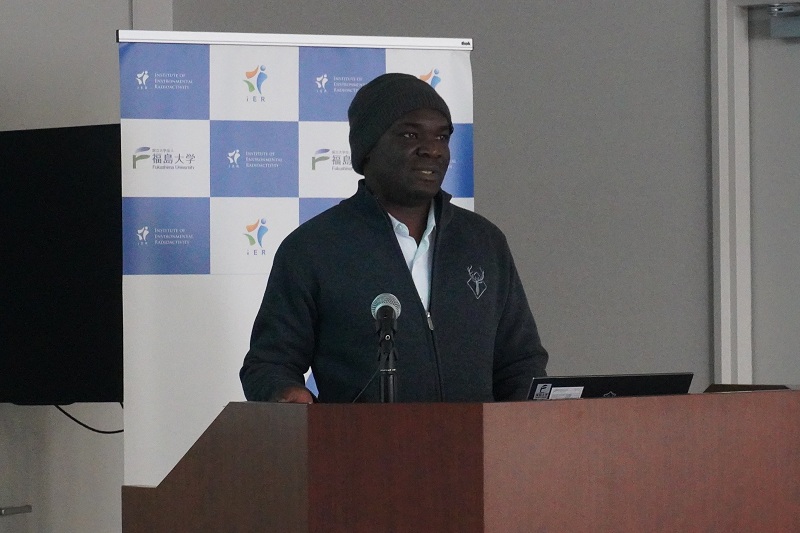
Project Researcher Orosun presented “Distribution of 137Cs in Japanese cedar and its implications for sustainable forest management in Fukushima.” This study synthesizes current knowledge on the uptake, radial transport, and temporal redistribution of radiocesium (137Cs) in Japanese cedar (Cryptomeria japonica) following the Fukushima Dai-ichi Nuclear Power Plant accident. It highlights the dual contamination pathways of foliar interception during the early phase and root uptake in the longer term. Evidence from field and tracer studies demonstrates active radial transport of 137Cs from sapwood to heartwood via ray parenchyma cells, followed by diffusion within heartwood. Species-specific differences in heartwood-to-sapwood concentration ratios are emphasized. The research integrates vertical and radial distribution dynamics, providing mechanistic insight into long-term wood contamination and implications for forest management and timber utilization.
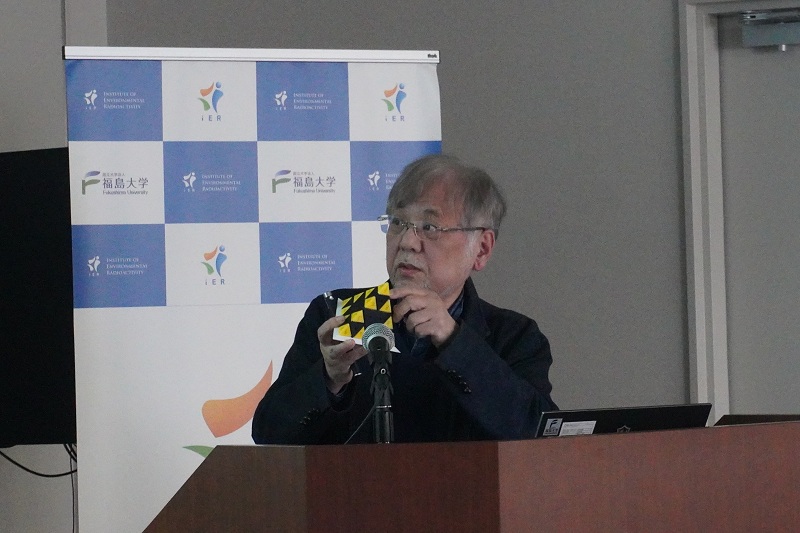
Project Professor Torii explained that the development of a compact imaging sensor capable of detecting three-dimensional, omnidirectional distributions of radiation is essential for locating radiation sources. He has developed radiation imagers capable of mapping the fractal-shaped distributions of beta and gamma rays. At the Fukushima Daiichi Nuclear Power Plant, the removal of nuclear fuel and debris is planned, making it critically important to identify neutron sources originating from nuclear fuel. He and his collaborators are working on the development of a compact, lightweight omnidirectional neutron imager to identify neutron sources within the reactor building. To this end, they are developing an omnidirectional neutron imager equipped with a thin scintillator for neutron detection. He presented the results of its design and detector performance tests.
After each presentation, various questions and comments were raised by participants.