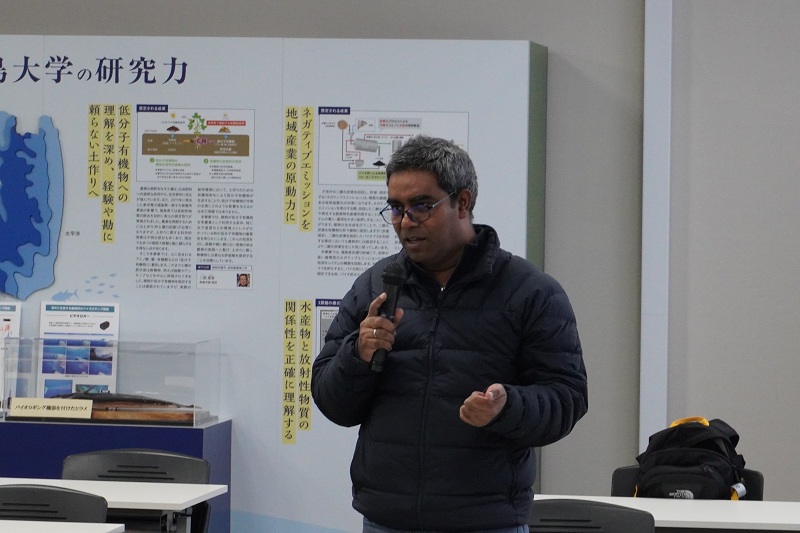
The 8th IER Seminar of FY2025 held on January 19, 2026 (Graduate Students)
| Date & Time | Monday, January 19, 2026, 13:30-14:30 JST |
| Venue | 6F Conference Room, IER Main Building / Online (Zoom) |
| Speaker | Abhijit BARUA (1st-year doctoral student, major in Environmental Radioactivity) SUN Shuhan (1st-year master’s student, major in Environmental Radioactivity) (Presentation order) |
| Lecture Title | Synthesis and characterization of binary mixed ferrites for wastewater treatment (Barua) Assessing Cs-137 root uptake using Tag(m2/kg) in Japanese red pine forests (Sun) |
| Participants | 20 |
Institute of Environmental Radioactivity (IER) regularly holds the IER Seminar in which the faculty members report on their research results, with the aim of facilitating their research activities and promoting communication.
In the 8th IER Seminar of this fiscal year that was held on January 19, 2026, two presentations were given by a doctoral student and a master’s student majoring in Environmental Radioactivity to 20 participating researchers and students as follows.
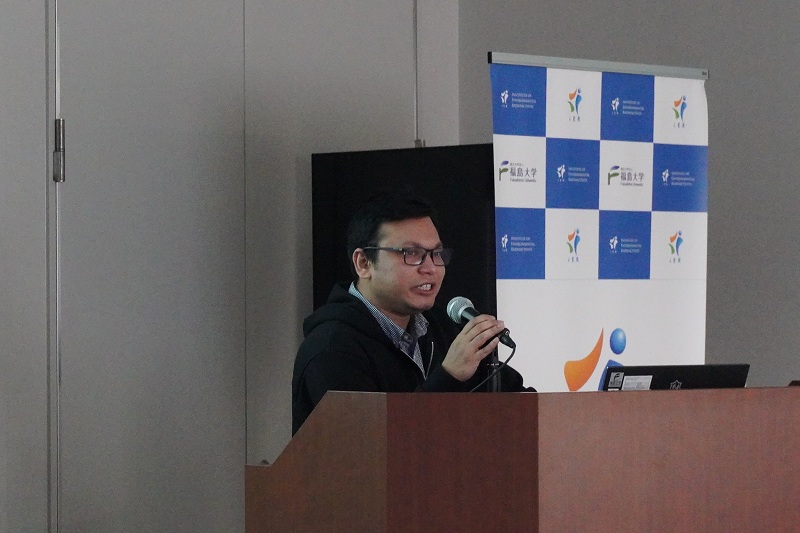
Mr. Barua from the Rahman Laboratory explained that binary spinel ferrites with the general formula AB2O4 are magnetic mixed metal oxides in which A and B sites are occupied by divalent (Co2+, Ni2+, Zn2+, or Mn2+) and trivalent (Fe3+) metal ions, respectively. These materials have been widely recognized as efficient and sustainable alternatives to conventional wastewater sorbents. In this work, two novel mixed binary ferrites, Cu0.5Mg0.5Fe2O4 and Mn0.5Mg0.5Fe2O4, were synthesized via an auto-combustion method by incorporating Cu and Mn into the MgFe2O4 lattice. Phase formation and crystallinity were confirmed by XRD, elemental composition and functional groups were analyzed by EDX and FTIR, surface morphology was examined by SEM, magnetic properties were evaluated using SQUID, and metal-ion separation performance was finally assessed in mixed aqueous systems.
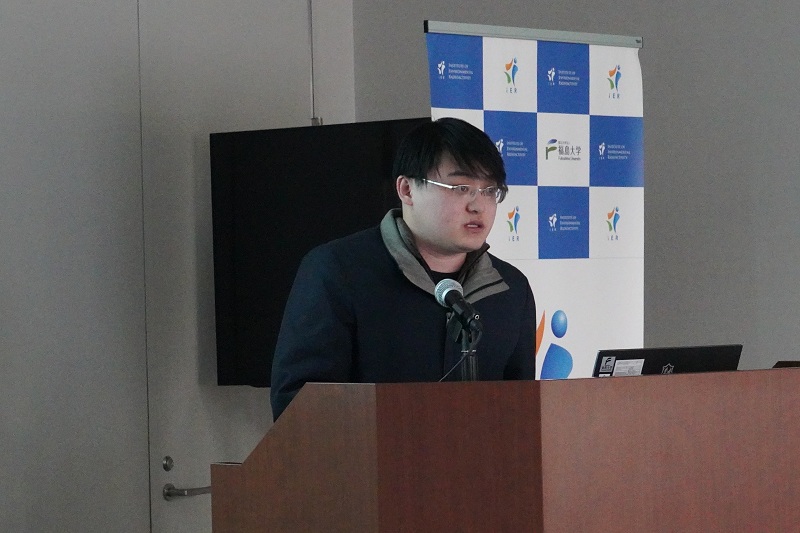
Mr. Sun from the Yoschenko Laboratory gave a presentation on assessing Cs-137 root uptake using Tag(m2/kg) in Japanese red pine forests. This presentation reported a pilot workflow to assess Cs-137 root uptake in a forest soil–pine system using a concentration-based target metric, Tag (m²/kg). A 0–30 cm soil core was sampled at high vertical resolution (0–5 cm in 1-cm layers; 5–30 cm in 5-cm layers), and one post-accident cultivated pine was separated into six compartments (inner/outer bark, stem wood, young/old branches, new needles). Cs-137 was measured on a dry-mass basis by HPGe gamma spectrometry. The soil profile showed strong near-surface retention, peaking at 4–5 cm (24,246 Bq/kg) and decreasing to 21.61 Bq/kg at 25–30 cm. Using a 5-cm inner-diameter core, the 0–30 cm soil inventory was 8.47×10⁵ Bq/m². Compartment Tag was calculated as Cplant (Bq/kg)/Isoil (Bq/m²), with the highest Tag in inner bark (4.55×10⁻⁴ m²/kg) and new needles (2.76×10⁻⁴ m²/kg). These results support feasibility for replicated mechanism-oriented studies.
After each presentation, various questions and comments were raised by participants.