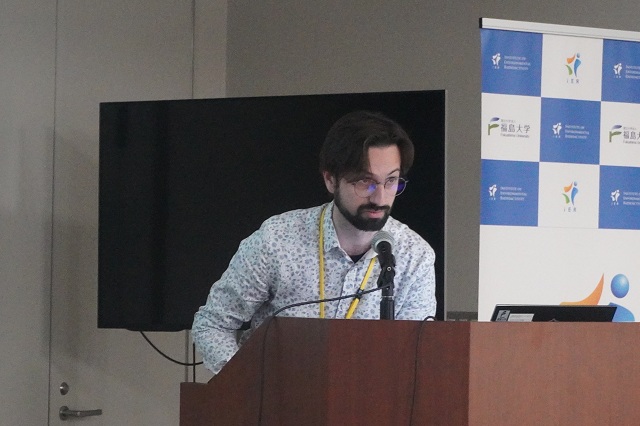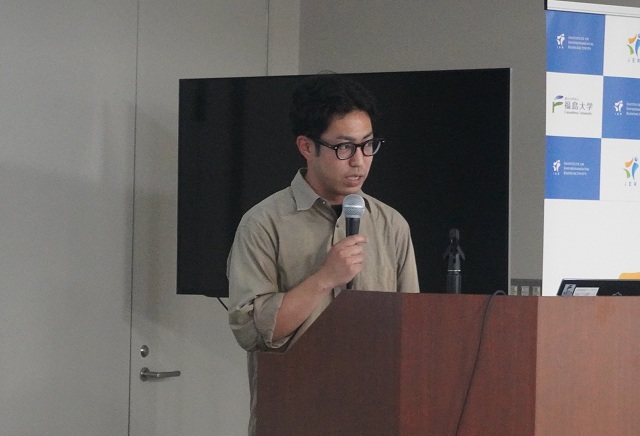
The 1st IER Seminar of FY2026 held on June 29, 2026 (International Visiting Scholar Cornillon, Project Researcher Kakuma)
| Date & Time | Monday, June 29, 2026, 13:30-14:30 JST |
| Venue | 6F Conference Room, IER Main Building / Online (Zoom) |
| Speakers | International Visiting Scholar Amaris CORNILLON Project Researcher KAKUMA Minato (Presentation order) |
| Lecture Titles | Megasolars in Fukushima: The battleground for a new regime of energy governance (Cornillon) Radiocesium transfer pathways in Fukushima river ecosystems — A field study focusing on the Japanese mitten crab — (Kakuma) |
| Participants | 24 |
Institute of Environmental Radioactivity (IER) regularly holds the IER Seminar in which the faculty members report on their research results, with the aim of facilitating their research activities and promoting communication.
In the 1st IER Seminar of this fiscal year that was held on June 29, 2026, two presentations were given by International Visiting Scholar Amaris CORNILLON and Project Researcher KAKUMA Minato to 24 participating researchers and students as follows.
International Visiting Scholar Cornillon gave a research presentation titled “Megasolars in Fukushima: The battleground for a new regime of energy governance,” focusing on the energy transition in Fukushima following the Fukushima Daiichi Nuclear Power Plant accident.
Project Researcher Kakuma presented radiocesium (137Cs) transfer pathways in Fukushima river ecosystems, focusing on the Japanese mitten crab, a migratory crustacean that connects freshwater, estuarine, and coastal habitats. The study examined how 137Cs retained in forested catchments may enter river food webs through river water, sediment, and dietary pathways. By analyzing stomach contents and body tissues separately, the presentation highlighted a framework for comparing recent dietary exposure with more time-integrated body burdens. The talk also discussed how local contamination, catchment characteristics, and dietary heterogeneity may jointly shape 137Cs accumulation in this fishery-relevant species.
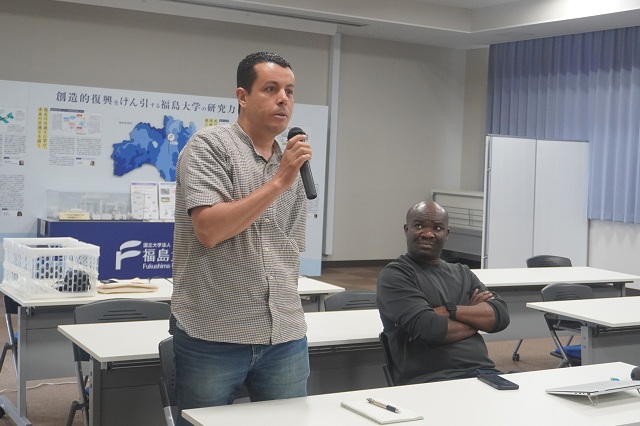
After each presentation, various questions and comments were raised by participants.