The 10th IER Seminar of FY2025 held on February 2, 2026 (graduate students)
| Date & Time | Monday, February 2, 2026, 13:30-15:00 JST |
| Venue | 6F Conference Room, IER Main Building / Online (Zoom) |
| Speakers | Kateryna KOREPANOVA (2nd-year doctoral student, major in Environmental Radioactivity) Iqbal HOSSEN (2nd-year doctoral student, major in Environmental Radioactivity) NIIDA Takuya (1st-year doctoral student, major in Environmental Radioactivity) (Presentation order) |
| Lecture Titles | Effect of radioactive contamination and ecological factors on population characteristics of Rodentia in the Chornobyl Exclusion Zone (Korepanova) Competitive effects of potassium, rubidium, and ammonium on cesium uptake by Japanese knotweed grown hydroponically (Hossen) Factors controlling dissolved 137Cs activities in Matsukawa-ura lagoon, a semi-closed estuary, after the Fukushima accident (Niida) |
| Participants | 22 |
Institute of Environmental Radioactivity (IER) regularly holds the IER Seminar in which the faculty members report on their research results, with the aim of facilitating their research activities and promoting communication.
In the 10th IER Seminar of this fiscal year that was held on February 2, 2026, three presentations were given by three doctoral students majoring in Environmental Radioactivity to 22 participating researchers and students as follows.
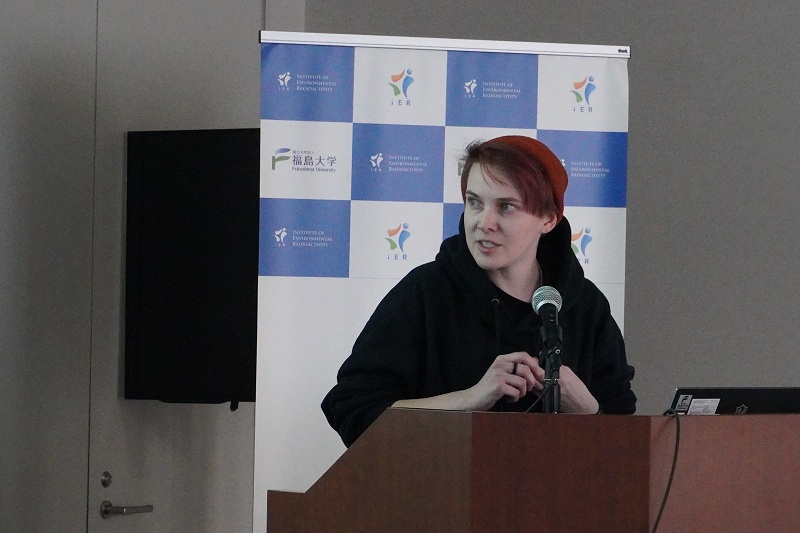
Ms. Korepanova from the Yoschenko Laboratory introduced her field study in the Chornobyl Exclusion Zone (Ukraine), which assessed whether radiation or environmental conditions better explained patterns in small-mammal (Rodentia) communities. She measured radiation parameters using portable devices (a Geiger counter with GPS, a dosimeter-radiometer, and a NaI scintillation gamma spectrometer) and conducted standardized sampling of rodents and insects as bioindicators. Community structure was assessed using Simpson’s dominance and Shannon’s diversity indices, and multiple predictors (e.g., temperature, gamma dose rate, predators, plant richness, soil moisture, soil carbon content) were tested. Preliminary results indicate that soil carbon content positively affects rodent abundance, while predator abundance has a slight negative effect; other predictors were not significant.
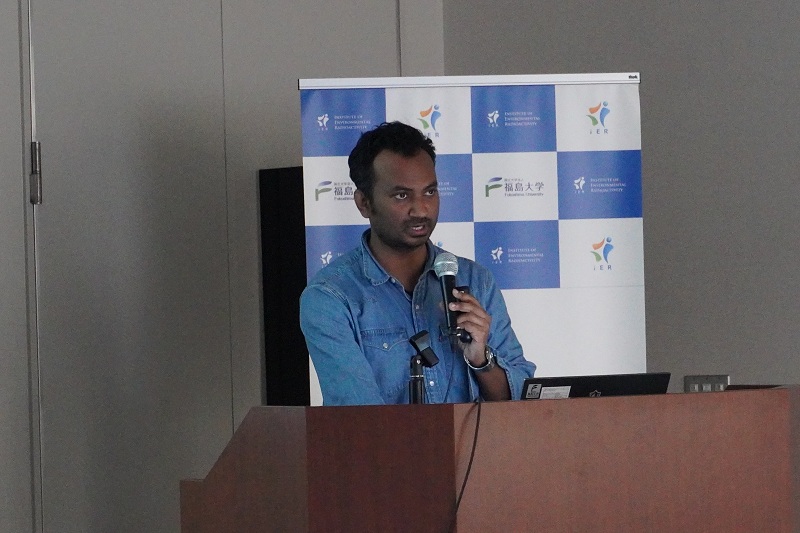
Mr. Hossen from the Rahman Laboratory presented on the phytoremediation potential of plants for radiocesium, a key contaminant affecting food-chain safety. In this study, stable Cs+ was used as an analogue to examine uptake by Japanese knotweed plant grown hydroponically under controlled conditions. Seeds were germinated under control, K+-supplemented (NS1: 2 mM; NS2: 6 mM), and K++ Cs+ treatments, then cultivated in nutrient solutions with varying K+ levels. Germination was highest at low K+ without Cs+, whereas higher K+ enhanced growth. Maximum Cs+ accumulation occurred in NS1 + Cs++ NH4+, where over 80% of absorbed Cs+ was retained in roots, indicating preferential root sequestration and limited translocation.
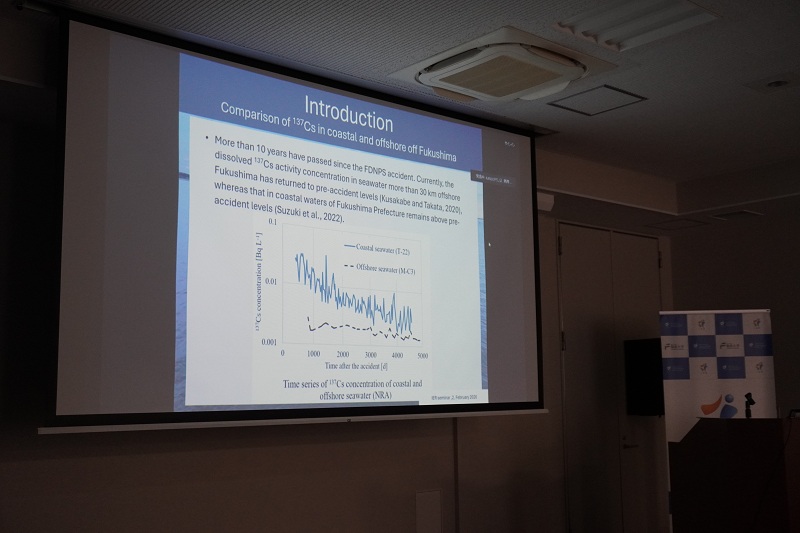
Mr. Niida from the Takata Laboratory presented on factors controlling dissolved 137Cs activity in Matsukawa-ura Lagoon, a semi-closed estuary, after the Fukushima accident. It was indicated that riverine and sedimentary inputs contributed to changes in dissolved 137Cs concentrations in the lagoon.
After each presentation, various questions and comments were raised by participants.