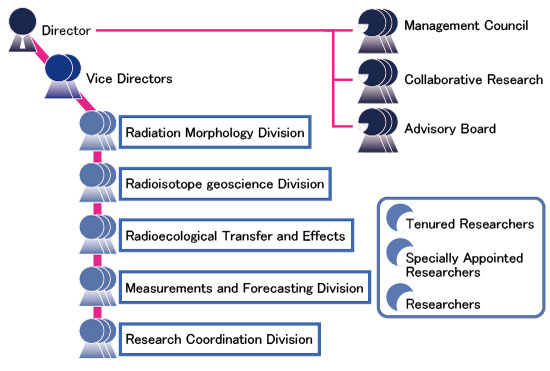
| Radiation Morphology Division |
| 1 |
Radionuclide Measurement and Reference Materials |
Develop and standardize sampling and measurement methods with international organizations for various types of environmental samples and sample matrices. |
| 2 |
Speciation-Radiochemistry |
Analyze chemical and physicochemical forms of radionuclides involved in the processes that govern their environmental transfer and migration. |
| Radioisotope geoscience Division |
| 3 |
Atmospheric Radionuclide Dynamics |
Research radionuclide transport in the atmospheric environment. |
| 4 |
Terrestrial Radionuclide Dynamics |
Research radionuclide transfer and migration in the terrestrial environment. |
| 5 |
Marine Radionuclide Dynamics |
Research radionuclide transfer in the marine environment. |
| 6 |
Radiological Hydrology |
Research radionuclide transfer from land to fresh water environments due to hydrological phenomena. |
| Radioecological Transfer and Effects |
| 7 |
Forest Radioecology |
Research radionuclide cycles in the forest ecosystems. |
| 8 |
Fresh Water Radioecology |
Research radionuclide transfer to biota in inland waters. |
| 9 |
Soil and Plant Dynamics |
Research radionuclide transfer in soil-plant system. |
| 10 |
Plant Radioecological Effects |
Research biological effects of radiation exposure to microbes, algae, and plants. |
| 11 |
Animal Radioecolgical Effects |
Research biological effects of radiation exposure to animals, with an emphasis on free-ranging wildlife. |
| Measurements and Forecasting Division |
| 12 |
Radiation and Transfer Modelling |
Evaluate and predict environmental radionuclide transfer and radiation through using computer simulations and other methods. |
| 13 |
Monitoring Systems Development |
Develop improved technologies to monitor and measure radiation. |
| 14 |
Mechatronics Systems Development |
Develop mechatronics systems and remote control technologies that will enable sampling and other operations in areas where humans cannot approach. |
| Research Coordination Division |
| 15 |
Data Archives and Statistics |
Analysis and archiving of research outputs and research samples produced by IER and other institutes around the world. Provision of these materials to researchers around the world upon their request. |
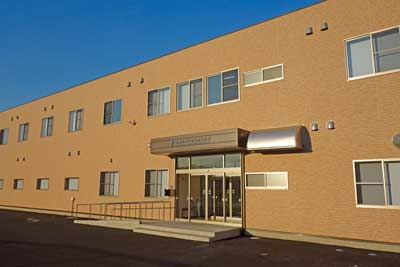 Established as the first affiliated research institute of Fukushima University, the Institute of Environmental Radioactivity aims to serve as a focal point of intellect and knowledge from scientists in elucidating the distribution and behavior of radioactivity in the environment. By closely cooperating with various research institutes within and outside the country and accepting scientists and specialists in the related disciplines from different parts of the world, we conduct research in forests, rivers, lakes, ocean and the air in Fukushima and utilize the results of our research in developing models and measurement instruments as well as create reference specimens.